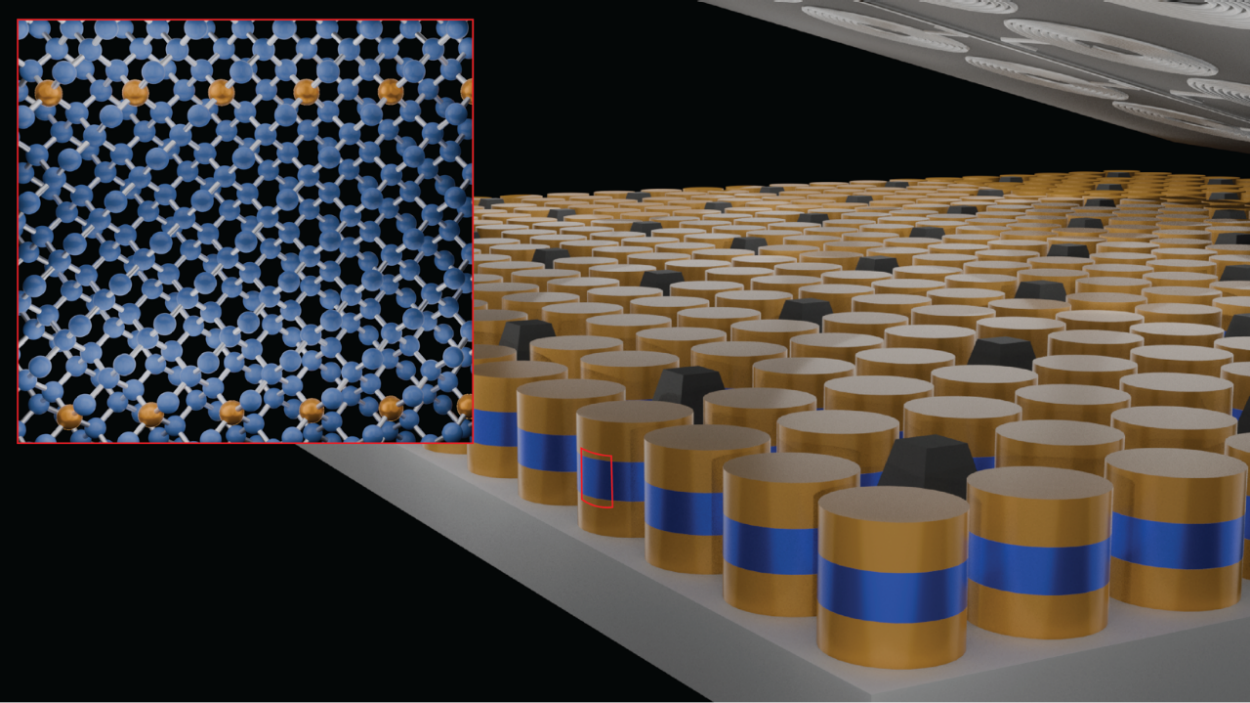





Scientists have long sought to make semiconductors—vital components in computer chips and solar cells—that are also superconducting, thereby enhancing their speed and energy efficiency and enabling new quantum technologies. However, achieving superconductivity in semiconductor materials such as silicon and germanium has proved challenging due to difficulty in maintaining an optimal atomic structure with the desired conduction behavior.
In a newly published paper in the journal Nature Nanotechnology, an international team of scientists reports producing a form of germanium that is superconducting—able to conduct electricity with zero resistance, which allows currents to flow indefinitely without energy loss, resulting in greater operational speed that requires less energy.
“Establishing superconductivity in germanium, which is already widely used in computer chips and fiber optics, can potentially revolutionize scores of consumer products and industrial technologies,” says New York University physicist Javad Shabani, director of NYU’s Center of Quantum Information Physics and the university’s newly established Quantum Institute, one of the paper’s authors.
“These materials could underpin future quantum circuits, sensors, and low-power cryogenic electronics, all of which need clean interfaces between superconducting and semiconducting regions,” adds Peter Jacobson, a physicist at the University of Queensland and one of the paper’s authors. “Germanium is already a workhorse material for advanced semiconductor technologies, so by showing it can also become superconducting under controlled growth conditions there’s now potential for scalable, foundry-ready quantum devices.”
Semiconductor materials such as germanium and silicon, both diamond-like crystals, are group IV elements, whose electronic behavior straddles that of metals and insulators. These materials are useful in manufacturing because of their flexibility and durability. Achieving superconductivity in these elements is accomplished by manipulating their structure to introduce numerous conducting electrons. These electrons interact with the germanium crystal to pair with one another and move without resistance—a process that has historically been challenging to control at the atomic level.