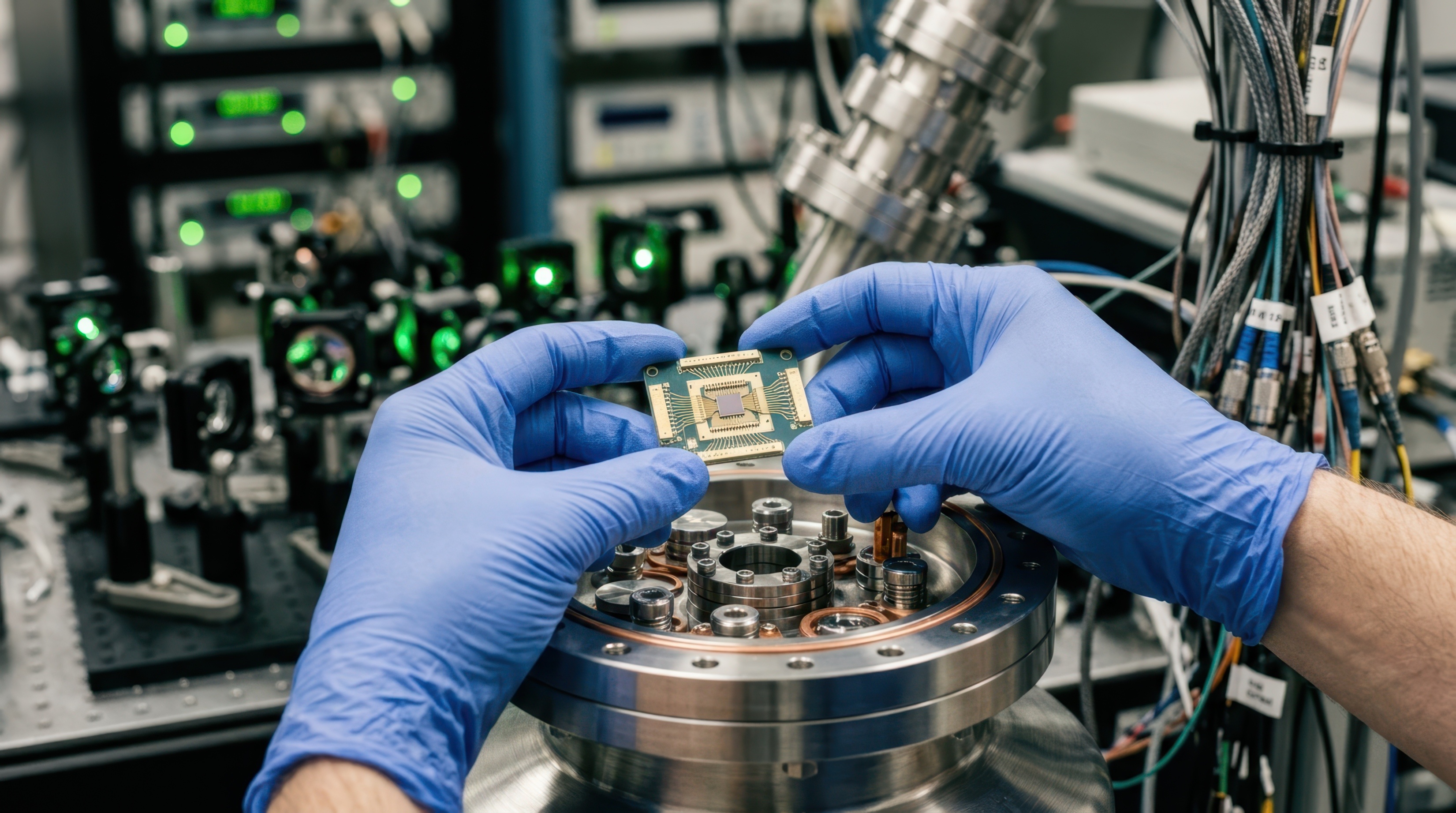





Researchers have demonstrated a new fabrication approach that enables the exploration of a broader range of superconducting materials for quantum hardware.
The study, published in Applied Physics Letters and selected as a “Featured” article, addresses a long-standing challenge: many promising superconductors, such as transition metal nitrides, carbides, and silicides, are difficult to pattern into functional devices using conventional chemistry-based methods.
By showing that physical patterning provides a viable alternative, the study paves the way to evaluate and harness these materials for high-performing quantum technologies.
The team, led by NYU Tandon professor Davood Shahrjerdi, demonstrated that one such technique, called low-energy ion beam etching (IBE), can be used to fabricate high-performing quantum devices. They validated the approach using niobium, a well-studied superconductor, and benchmarked the resulting devices against state-of-the-art counterparts made with conventional chemistry-based methods, showing comparable performance.
Quantum computers have the potential to tackle problems that are intractable for today's machines, with applications in drug discovery, cryptography, and financial modeling.
"Realizing this promise requires components that can preserve fragile quantum states long enough to perform complex calculations," said Shahrjerdi. "That means building ever more perfect hardware to reduce errors and improve the fault tolerance of quantum systems."
The team's demonstration advances this broader goal by expanding the superconducting material toolkit for device fabrication.